
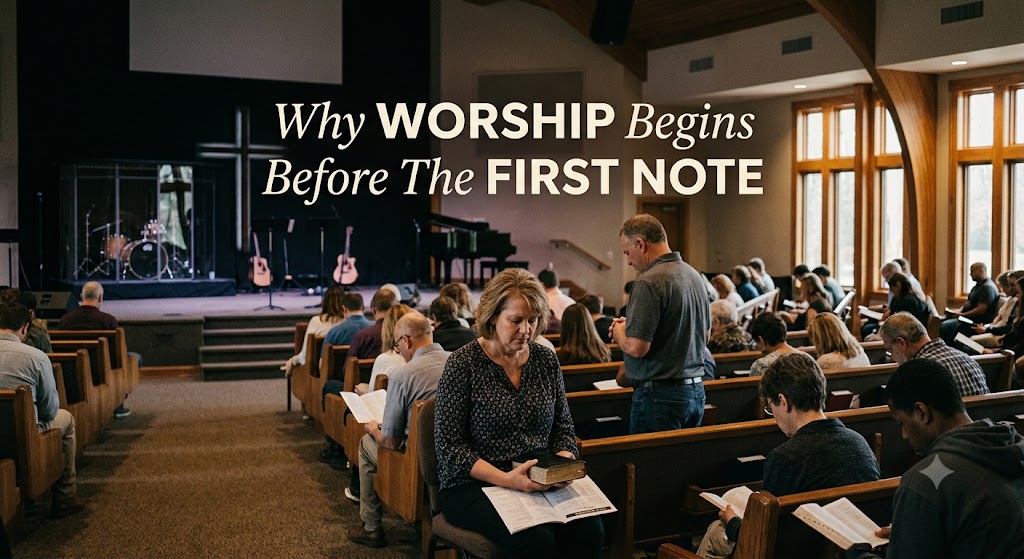
Why Worship Begins Before the First Note
Why Worship Begins Before the First Note is a question that every worshipper, worship leader, musician, choir member and Christian should take seriously. Many people associate worship with music. They think worship begins when the keyboard starts playing, when the guitarist strikes the first chord, when the drummer begins the rhythm, or when a worship leader steps onto the platform and lifts a microphone. But biblical worship is much deeper than a musical performance. Worship does not begin when the sound begins. It begins in the heart long before anyone hears a note.
A person can sing beautifully and still fail to worship. Someone can have an extraordinary voice, perfect musical timing and impressive stage presence while their heart is completely disconnected from God. At the same time, someone who cannot sing professionally can offer genuine worship through a simple song because their heart is surrendered to God. This is one of the most important truths about Christian worship. God is not primarily listening for musical perfection. He is looking at the heart behind the sound.
Understanding why worship begins before the first note changes the way we approach Christian music. It changes the way worship leaders prepare for church services. It changes the way musicians practise. It changes the way congregations participate. Most importantly, it changes the way believers understand worship itself.
Worship begins with recognition. Before the first note is played, the worshipper must recognise who God is. Worship is a response to the character, greatness, goodness, holiness, mercy and love of God. When you truly understand who you are worshipping, music becomes an expression rather than the foundation of your worship.
This is why preparation for worship should begin before entering the church building. It should begin before picking up an instrument. It should begin before opening the microphone. It should begin before the worship team gathers for rehearsal. The heart should already be turning towards God.
Imagine someone receiving an invitation to meet an important person. They would probably prepare themselves before the meeting. They would think about what they want to say, how they should behave and what the meeting means. Yet Christians sometimes approach worship without any preparation of the heart. They arrive distracted, exhausted, angry, worried about money, thinking about social media, checking messages and waiting for the music to create an emotional atmosphere before they become aware of God.
There is nothing wrong with music creating an emotional response. Music is powerful. It can move memories, awaken emotions and help people express feelings that words alone cannot communicate. Christian music can encourage, comfort and remind believers of biblical truths. But emotional response and genuine worship are not always the same thing.
Why Worship Begins Before the First Note becomes clear when we understand that worship is fundamentally about surrender. The song is simply one of the ways that surrender becomes visible and audible. If the heart has not surrendered, the song can become nothing more than sound.
Why Worship Begins Before the First Note
This is particularly important for worship leaders. A worship leader is not merely someone who knows how to sing Christian songs. A worship leader carries the responsibility of helping direct the attention of a congregation towards God. That responsibility begins long before standing on a platform.
Preparation for worship should involve prayer, reflection and spiritual examination. A worship leader may spend hours practising a song but only a few minutes examining their heart. Yet technical preparation without spiritual preparation can produce an impressive performance without genuine ministry.
The question should not only be, “Do I know the song?” It should also be, “What is this song saying about God?” “Do I believe what I am singing?” “Am I personally living according to the message I am asking others to sing?” “Am I prepared to surrender myself to the God I am about to lead people towards?”
These questions can be uncomfortable, but they are necessary.
Worship is not about pretending to be spiritually perfect. Every Christian has struggles. Every worship leader has difficult days. Every musician can experience discouragement, temptation, frustration and weakness. Genuine worship does not require pretending that these things do not exist. Instead, genuine worship invites us to bring our real selves before God.
Sometimes the most meaningful worship happens when someone comes before God with a broken heart and says, “Lord, I do not understand what is happening, but I still trust You.” That declaration can be more powerful than a flawless musical performance.
This is another reason why worship begins before the first note. Before the music starts, there is already a decision to trust God.
Worship is also connected to obedience. It is possible to sing about surrender while refusing to surrender. It is possible to sing about forgiveness while holding tightly to bitterness. It is possible to sing about generosity while living selfishly. It is possible to sing about holiness while deliberately embracing habits that pull us away from God.
This does not mean Christians must become perfect before they can worship. If perfection were a requirement, nobody could worship. Instead, worship should move us towards obedience. What we sing should influence how we live.
A worship song about surrender should challenge us to surrender. A song about forgiveness should challenge us to forgive. A song about God’s faithfulness should remind us to trust Him. A song about love should influence how we treat people. A song about holiness should challenge our choices.
When worship becomes disconnected from daily life, it can easily become performance.
The Bible repeatedly presents worship as something that involves the whole person. Romans 12:1 describes believers presenting their bodies as living sacrifices, holy and acceptable to God, as an act of worship. This picture is far bigger than singing. It includes our decisions, relationships, priorities, attitudes, resources, time and behaviour.
This means that worship can happen in a car before church. It can happen while washing dishes. It can happen during a difficult conversation when you choose patience instead of anger. It can happen when you refuse to participate in dishonesty even though dishonesty would benefit you. It can happen when you forgive someone who hurt you. It can happen when you choose integrity when nobody is watching.
The song is only one expression of something much bigger.
For Christian musicians, this understanding should completely change the way they view their instruments. A keyboard is not merely equipment. A guitar is not merely equipment. Drums are not merely equipment. A microphone is not merely equipment. They become tools through which something already present in the heart can be expressed.
The musician’s heart matters.
A worship team can spend hours discussing musical arrangements while ignoring the spiritual condition of the people on the stage. They can debate keys, transitions, tempos and harmonies while failing to pray together. Technical excellence matters because Christians should pursue excellence in what they do, but excellence without the right heart can become another form of performance.
There is nothing wrong with wanting the music to sound good. In fact, musicians should practise. Worship leaders should develop their voices. Instrumentalists should improve their skills. Choirs should rehearse. Sound engineers should prepare properly. Churches should pursue order and excellence.
But excellence should serve worship, not replace it.
The goal is not to impress the congregation with musical ability. The goal is to help people focus on God.
This distinction becomes particularly important in an age where Christian music exists within a massive entertainment ecosystem. Worship songs can become popular on streaming platforms, social media and video sharing sites. Christian artists can build enormous audiences. Worship music can become commercially successful. None of these things are automatically wrong, but they create a temptation that every Christian musician must recognise.
The temptation is to seek applause from people instead of approval from God.
When worship becomes about being noticed, the heart slowly shifts away from the One being worshipped. A worship leader may begin thinking more about how the audience responds than whether God is honoured. A singer may become obsessed with vocal performance. A musician may care more about becoming famous than becoming faithful.
This is why worship begins before the first note. The battle for the heart happens before the microphone is switched on.
Before stepping onto the platform, the worshipper must decide who deserves the glory.
This principle also applies to the congregation. Worship is not something that the worship team performs while everyone else watches. The congregation is not an audience at a concert. Christian worship is participation.
Sometimes people complain that the worship team did not create the right atmosphere. They say the music was too slow, the songs were not familiar enough, the sound was poor or the worship leader did not generate enough excitement. While there can certainly be legitimate issues with church music and leadership, believers must also remember that worship does not depend entirely on external atmosphere.
If your worship only exists when the lights are dim, the music is beautiful and your favourite song is being played, then your understanding of worship may need to become deeper.
Can you worship when the song is unfamiliar?
Can you worship when the sound system fails?
Can you worship when your favourite worship leader is not present?
Can you worship when you are waiting for an answer to prayer?
Can you worship when life is uncomfortable?
Can you worship when nobody is watching?
These questions reveal whether worship is connected to music or rooted in relationship with God.
Some of the deepest worship in Scripture happened in difficult circumstances. Worship was not always associated with comfort. There were moments when God’s people worshipped while facing uncertainty, persecution, loss and opposition.
That teaches us something important. Worship is not a reward for having a perfect life. Worship is a declaration of God’s worth regardless of our circumstances.
This does not mean Christians should ignore pain or pretend everything is fine. Biblical worship can include tears. It can include questions. It can include silence. It can include waiting. It can include honest conversations with God.
Sometimes worship is not shouting. Sometimes worship is simply refusing to walk away from God.
Sometimes worship is saying, “I still believe.”
Sometimes worship is saying, “I do not understand, but I trust You.”
Sometimes worship is continuing to pray when the answer has not arrived.
Sometimes worship is choosing gratitude even when circumstances are difficult.
That kind of worship begins long before the first note.
There is also a powerful connection between worship and gratitude. Gratitude prepares the heart for worship because it shifts our attention from what we lack to what God has already done. A person who intentionally remembers God’s goodness can enter worship with a different perspective.
Before singing, think about God’s faithfulness.
Think about the times you survived situations you thought would destroy you.
Think about prayers that were answered.
Think about doors that opened.
Think about protection you did not even recognise at the time.
Think about people God placed in your life.
Think about grace.
Think about mercy.
Think about the simple gift of being alive.
These reflections can prepare the heart to worship because worship is ultimately a response to God’s worth.
For worship leaders, this means the ministry begins at home. It begins in private devotion. It begins in prayer when nobody is watching. It begins when the Bible is opened without a microphone nearby. It begins when character is developed away from the stage.
A person cannot consistently lead others into places they refuse to visit privately.
If worship only exists on Sunday, something is missing.
The strongest worship leaders are not necessarily the people with the biggest voices. They are often people whose private lives give credibility to their public ministry. They understand that the platform does not create worship. It reveals what has already been developing in the heart.
This is why Christian musicians should be careful about separating ministry from character. Talent can open doors, but character determines what happens after the door opens.
A gifted musician without humility can become difficult to work with. A talented singer without discipline can become unreliable. A successful Christian artist without accountability can become vulnerable to pride. A powerful worship leader without a private relationship with God can eventually discover that public ministry has become an empty routine.
Worship requires the heart before it requires the voice.
It also requires listening. We often think worship is about speaking, singing and making sound. But genuine worship includes listening to God through Scripture and allowing His truth to challenge us.
Before we ask God to hear our song, we should be willing to hear His Word.
Before we ask people to lift their hands, we should be willing to surrender our own hands and plans.
Before we sing about giving everything to God, we should examine what we are still holding back.
That is why Why Worship Begins Before the First Note is more than a statement about music. It is a statement about Christian living.
Worship begins when you wake up and decide that your day belongs to God.
It begins when you choose integrity over convenience.
It begins when you forgive.
It begins when you pray.
It begins when you serve.
It begins when you refuse to compromise your values.
It begins when you acknowledge God in ordinary moments.
It begins when you recognise that your life itself can become an offering.
Then, when the first note finally plays, the music becomes an overflow of something deeper.
The keyboard is no longer creating worship. It is expressing worship.
The guitar is no longer creating worship. It is expressing worship.
The voice is no longer creating worship. It is expressing worship.
The congregation is no longer waiting for worship to happen. They are joining something that has already begun in their hearts.
This is what makes Christian worship different from entertainment. Entertainment asks, “How did this make you feel?” Worship asks, “How did this honour God?”
Entertainment can be judged by applause. Worship is measured by surrender.
Entertainment can end when the music stops. Worship continues when the music ends.
That may be the clearest answer to why worship begins before the first note. If worship only exists while music is playing, then it is dependent on music. But if worship is rooted in surrender to God, then worship continues long after the final chord.
The music may stop, but obedience continues.
The singing may stop, but faith continues.
The instruments may become silent, but worship continues through the choices we make.
The church service may end, but worship continues in the workplace, the home, the classroom, the marketplace and the private places where nobody sees us.
The next time you hear a worship song begin, do not only listen to the melody. Think about the heart behind the sound. Ask yourself what the song is calling you to believe, surrender, remember or change.
And before you sing, prepare your heart.
Before you lift your hands, examine your heart.
Before you lead others, meet with God privately.
Before the first note, remember who you are singing to.
Because the most powerful worship is not necessarily the loudest worship. It is the worship that comes from a heart that has already decided that God is worthy.
The first note is simply the sound of something that started much earlier.
Worship begins in the heart.
Worship begins in surrender.
Worship begins in obedience.
Worship begins in gratitude.
Worship begins in faith.
Worship begins when we recognise God’s worth.
And that is ultimately why worship begins before the first note.

Leave a Reply