
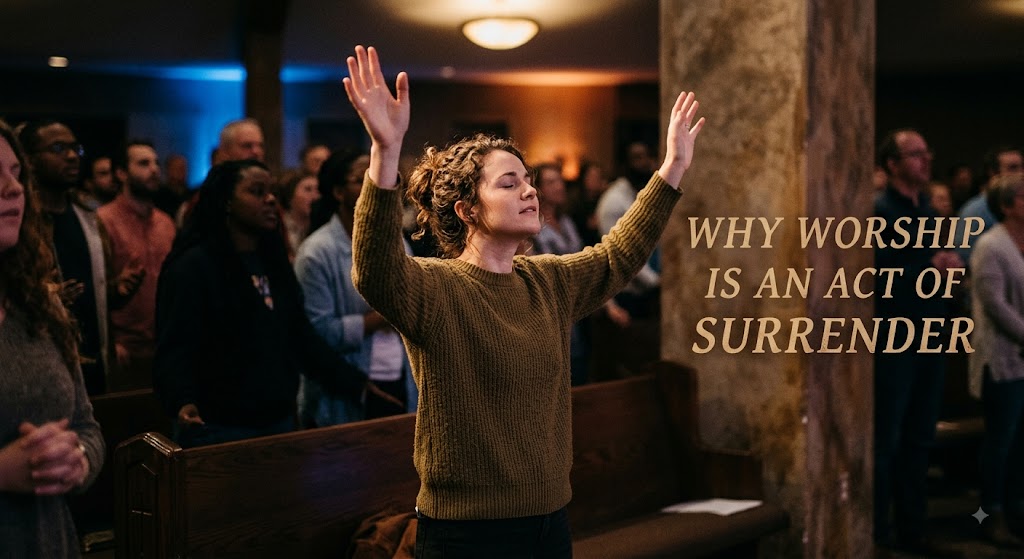
Why Worship Is an Act of Surrender
Worship is often described as singing, lifting our hands, bowing our heads, dancing, praying, or gathering together with other believers to honour God. These expressions are beautiful and important, but worship is much deeper than what happens when a song begins playing. True worship reaches into the heart, challenges our desires, changes our priorities, and calls us to place our lives completely in the hands of God. This is why worship is an act of surrender. It is not simply about what comes from our lips. It is about what we are willing to release from our hands.
Why Worship Is an Act of Surrender is a question that takes us to the very heart of what it means to follow God. When we worship sincerely, we acknowledge that God is greater than our plans, stronger than our fears, wiser than our understanding, and worthy of our complete trust. Worship becomes an intentional decision to stop insisting on having everything under our control and to recognise that our lives ultimately belong to God.
Many people find it easy to worship when life is going well. When prayers appear to be answered, opportunities are opening, finances are improving, relationships are peaceful, and the future looks promising, lifting our voices in praise can feel natural. But genuine surrender becomes visible when circumstances do not match our expectations. It is easy to say that God is good when everything makes sense. It is another thing to continue trusting Him when the answers have not come, the door has remained closed, and the road ahead is uncertain.
This is where the depth of worship is revealed. Worship is not only saying, “God, I thank You for what You have given me.” It is also saying, “God, I trust You even when I do not understand what You are doing.” That kind of worship requires surrender because it demands that we release our need to understand everything before we trust God.
Surrender does not mean giving up on life, becoming passive, or refusing to make decisions. Biblical surrender is not weakness. It is the conscious decision to place our will under God’s will. It means recognising that our perspective is limited while God’s understanding is complete. It means being willing to say, “Lord, this is what I want, but I choose to trust what You want.”
One of the greatest struggles human beings face is the desire for control. We want to know what will happen tomorrow. We want to determine how people will treat us. We want to control our careers, finances, relationships, reputation, plans, and future. We often become anxious when we realise that some things are completely outside our control. Worship confronts this desire by reminding us that God remains sovereign even when our circumstances appear chaotic.
When we worship, we are declaring that God is still God even when we do not have all the answers. That declaration requires humility. It requires us to acknowledge that we are not the centre of the universe and that our understanding is not the final authority.
This is one reason worship can be uncomfortable. We sometimes want worship to make us feel better without requiring anything from us. We want encouragement without correction, blessings without obedience, promises without patience, and victory without surrender. Yet authentic worship asks something deeper from us. It asks us to give God access to the areas of our lives we would rather control ourselves.
A person can sing loudly while secretly refusing to surrender. Someone can know every worship song and still resist God’s direction. Someone can lift their hands in church while holding tightly to resentment, pride, greed, bitterness, fear, or an unhealthy attachment to personal plans. External worship can be visible, but internal surrender is where transformation happens.
This does not mean that emotional expressions of worship are meaningless. Singing, dancing, clapping, kneeling, raising hands, and other forms of worship can be powerful expressions of genuine faith. The problem arises when the expression becomes a substitute for obedience. God is not merely interested in the sound of our worship. He is interested in the condition of the heart behind it.
True worship says, “God, I do not want to praise You only because of what You can give me. I want to honour You because of who You are.” That distinction is important. If our worship depends entirely on receiving what we want, then our worship can easily become transactional. We praise because we expect something in return. We pray because we want an outcome. We worship because we want God to change our circumstances.
But surrender teaches us another way. It teaches us to worship God even when the outcome is different from what we expected.
The Bible repeatedly presents surrender as a central part of a life devoted to God. Romans 12:1 describes believers as presenting their bodies as a living sacrifice, holy and pleasing to God, and identifies this as an act of worship. This picture is powerful because a sacrifice is something placed completely in God’s hands. It is no longer controlled by the person who brought it.
A living sacrifice is especially challenging because it involves our everyday lives. Worship is not restricted to Sunday morning or a particular building. It includes the way we work, speak, treat people, spend money, handle disappointment, respond to criticism, manage success, and make decisions when nobody is watching.
This means that worship can happen in places where there is no music at all.
You can worship God by choosing honesty when dishonesty would benefit you. You can worship by forgiving someone who hurt you. You can worship by refusing to compromise your values for financial gain. You can worship by being faithful when nobody applauds you. You can worship by obeying God when obedience costs you something. You can worship by surrendering an unhealthy relationship, a destructive habit, an inflated ego, or a personal ambition that has become more important to you than God.
Sometimes the greatest worship is not the song you sing but the decision you make after the song ends.
There are moments when surrender requires us to release something we desperately want. Perhaps we have created a specific picture of how our lives should look. We have imagined a particular career, marriage, financial position, ministry, opportunity, or future. When reality does not follow that picture, disappointment can become deep. We may begin asking God why He has not done what we expected.
Surrender does not mean that we stop having desires. It means that our desires no longer become conditions we place on God.
We can ask God for what we want while still being willing to accept His wisdom. We can pray passionately while remaining surrendered. We can pursue our goals while acknowledging that God’s direction matters more than our preferred outcome.
This is one of the hardest forms of faith because surrender requires trust before certainty. We would often prefer God to explain everything first and ask us to surrender afterwards. But faith frequently works in the opposite direction. We surrender first, trusting that God sees what we cannot see.
Think about a child holding the hand of a parent while crossing an unfamiliar road. The child may not understand the traffic, the timing, or the dangers around them. Yet the child can move forward because the person holding the hand understands what the child cannot see. In a similar way, surrender is an expression of trust in God’s greater perspective.
Worship therefore becomes a declaration of dependence. We are saying, “God, I need You.” That statement challenges modern culture because society often celebrates self sufficiency. We are encouraged to believe that we can create everything ourselves, solve everything ourselves, and become completely independent.
But Christianity teaches dependence on God. We may work hard, plan wisely, learn skills, develop businesses, build careers, and make responsible decisions, but ultimately our confidence cannot rest entirely on our own ability. Worship brings us back to the truth that our lives are gifts and that our strength is not self created.
Surrender also changes the way we respond to difficult seasons. When life becomes painful, people often respond in one of two ways. They may move closer to God or withdraw from Him. Worship gives us a third perspective. Instead of pretending that pain does not exist, worship allows us to bring our pain into God’s presence.
Some of the most powerful worship can come from a broken heart. There are moments when a person cannot explain what they are feeling but can still whisper, “God, I trust You.” There are moments when tears become part of the prayer. There are moments when worship is not energetic or emotional but quiet and deeply personal.
That kind of worship is surrender because the person is choosing to remain connected to God despite circumstances that could easily produce bitterness.
Surrender also involves surrendering our timeline. This can be extremely difficult. We live in a culture that values speed. We want immediate results, instant answers, quick success, rapid growth, and immediate solutions. Waiting can feel like failure. But God does not operate according to our preferred timetable.
Worship during a waiting season says, “God, I trust Your timing.”
That does not mean waiting is easy. It does not mean disappointment disappears. It means we refuse to allow impatience to become the master of our decisions. We continue praying. We continue obeying. We continue preparing. We continue trusting.
There is also a surrender of reputation. Following God can sometimes require making choices that other people do not understand. Not everyone will appreciate your convictions. Not everyone will agree with your priorities. Not everyone will celebrate your obedience.
If our worship depends on human approval, our obedience will always be fragile.
Surrender teaches us that God’s approval matters more than applause. This is particularly important in an age where social media has made public opinion incredibly powerful. People can become addicted to likes, comments, followers, shares, and validation. They can gradually shape their lives around what receives attention.
But worship redirects the heart. Instead of asking, “What will people think?” surrender asks, “What is pleasing to God?”
That question can change an entire life.
Surrender also means giving God our fears. Fear often reveals what we are trying desperately to protect. We may fear failure, rejection, poverty, loneliness, uncertainty, disappointment, or losing something we value. Worship does not always make those fears disappear instantly. Instead, it gives us somewhere to place them.
Why Worship Is an Act of Surrender
When we worship, we acknowledge that our fears are real but that they are not greater than God.
The same applies to our past. Some people struggle to surrender because they are constantly carrying guilt, shame, regret, or memories of previous failures. They may believe that because they made terrible decisions in the past, their future must remain defined by those decisions.
Surrender involves releasing the past into God’s mercy and allowing Him to shape what comes next. It does not mean ignoring consequences or refusing to learn from mistakes. It means refusing to make past failure the final definition of your identity.
There is also a surrender of success. This is something many people overlook. We often talk about surrendering pain, problems, and difficulties, but success can be just as dangerous when it becomes an idol.
When everything starts working, we can begin believing that we no longer need God. We can become proud of our achievements and gradually shift our confidence from the Creator to the things we have created.
Worship protects the heart by reminding us where our blessings come from. It teaches us to receive success with gratitude rather than arrogance.
A successful person who worships sincerely can say, “God, whatever You have given me belongs to You. Help me use it well.” That attitude changes how someone handles money, influence, talent, opportunities, and recognition.
This is particularly important for Christian musicians and worship leaders. Talent can create opportunities, but talent alone does not produce spiritual depth. A gifted musician can become more interested in applause than ministry. A powerful voice can become an instrument of personal fame rather than worship.
The heart behind the music matters.
A worship leader must continually surrender ego, ambition, insecurity, competition, and the desire for recognition. The purpose of worship is not to make the worshipper look impressive. It is to direct attention towards God.
This is why worship is an act of surrender. We surrender the need to be seen so that God can be honoured. We surrender our desire for control so that we can trust His direction. We surrender our plans so that we can remain open to His purpose. We surrender our fears so that faith can grow. We surrender our pride so that humility can take root.
The beautiful thing about surrender is that it does not diminish us. It frees us.
When we stop trying to control everything, we discover the peace that comes from trusting God with what we cannot control. When we stop demanding that life follow our exact plan, we become more capable of recognising unexpected opportunities. When we stop depending entirely on human approval, we become more courageous. When we surrender our future, we become more present in today.
Worship therefore becomes more than a religious activity. It becomes a posture of life.
You can worship God while working. You can worship while studying. You can worship while raising a family. You can worship while building a business. You can worship while serving your community. You can worship while travelling. You can worship while sitting quietly in your room.
The question is not simply whether music is playing. The deeper question is whether your heart is surrendered.
There will be days when worship feels easy and days when it feels difficult. There will be mornings when gratitude comes naturally and nights when you have to choose faith deliberately. There will be seasons when you understand what God is doing and seasons when His ways seem completely mysterious.
But surrender gives worship its depth.
When you worship during abundance, you acknowledge God as your provider. When you worship during uncertainty, you acknowledge Him as your guide. When you worship during pain, you acknowledge Him as your comfort. When you worship during success, you acknowledge Him as the source of your blessings. When you worship during waiting, you acknowledge Him as trustworthy.
This is why Why Worship Is an Act of Surrender is more than a theological idea. It is an invitation to examine the condition of our hearts.
What are you still trying to control?
What are you afraid to place in God’s hands?
What desire has become so important that you struggle to accept any answer other than the one you want?
What part of your life do you worship God with your lips while refusing to surrender it with your actions?
These questions may be uncomfortable, but they can lead to genuine transformation.
Perhaps surrender for you means letting go of a relationship that is taking you away from God. Perhaps it means forgiving someone. Perhaps it means changing your priorities. Perhaps it means accepting that your original plan may not be God’s plan. Perhaps it means trusting God with your finances. Perhaps it means stepping into a calling you have been avoiding. Perhaps it means releasing a fear that has controlled your decisions for years.
Whatever it looks like, surrender begins with trust.
And trust grows when we remember who God is.
The heart of Christian worship is not simply the beauty of the melody. It is the recognition that God is worthy. He is worthy when the answer is yes. He is worthy when the answer is wait. He is worthy when the road is clear. He is worthy when the path is confusing. He is worthy when we understand. He is worthy when we do not.
That is the difference between conditional praise and surrendered worship.
Conditional praise says, “I will worship if You do what I want.”
Surrendered worship says, “I will worship because You are God.”
That is a powerful difference.
When worship becomes surrender, our songs begin to carry a different meaning. We are no longer merely singing words. We are making declarations with our lives. Every act of obedience becomes an expression of worship. Every surrendered desire becomes an offering. Every decision to trust God becomes a statement of faith.
The greatest worship may therefore happen in moments nobody sees.
It may happen when you choose integrity instead of dishonesty.
It may happen when you forgive instead of retaliate.
It may happen when you remain faithful instead of giving up.
It may happen when you continue praying after disappointment.
It may happen when you trust God with tomorrow instead of allowing anxiety to consume today.
It may happen when you choose obedience even though nobody will applaud you.
It may happen when you kneel beside your bed and simply say, “Lord, I surrender.”
That prayer can be more powerful than a thousand words spoken without a surrendered heart.
Why Worship Is an Act of Surrender ultimately reminds us that worship is not merely something we do. It is something we become. It is a posture of humility, trust, obedience, gratitude, dependence, and love. It is the decision to place God above our preferences and His will above our pride.
A surrendered life does not mean a perfect life. We will still struggle. We will still question. We will still become afraid. We will still make mistakes. But surrender means that when we recognise ourselves drifting away, we return to God.
We place our plans back in His hands.
We place our future back in His hands.
We place our relationships back in His hands.
We place our ambitions back in His hands.
We place our fears back in His hands.
We place our success back in His hands.
We place our failures back in His hands.
And above everything else, we place ourselves back in His hands.
That is the heart of worship.
So the next time you hear a powerful worship song, do not only listen to the melody. Listen to the invitation behind the words. Ask yourself what God may be asking you to surrender. Do not allow worship to remain a moment that begins when the music starts and ends when the music stops.
Let worship follow you into your decisions.
Let it follow you into your relationships.
Let it follow you into your work.
Let it follow you into your private life.
Let it influence the way you respond when things go wrong.
Let it shape the way you behave when nobody is watching.
Because true worship is not simply the sound coming out of your mouth. It is the posture of your heart before God.
And sometimes the most powerful worship you can offer is not a song.
It is surrender.

Leave a Reply